
Wedding Photography Styles: The Ultimate Guide to Choosing the Right Style for Your Wedding
A Singapore-focused guide to wedding photography styles, with practical comparisons, the Weddingserv STYLE framework, venue and personality advice, and answers to common questions.
14 Jul 2026

Choosing a wedding photographer is not just about beautiful pictures. Wedding photography style shapes how your wedding will be captured and remembered: cinematic and dramatic, soft and romantic, polished and editorial, or candid and emotionally honest.
Two photographers may charge similar prices yet deliver very different experiences and galleries because of how they shoot, direct, light and edit.
This guide compares the major wedding photography styles, their trade-offs and how to choose the right fit for your personality, venue and priorities.
Quick answer: what are the main wedding photography styles?
The most common wedding photography styles are cinematic, timeless, loose editorial, classic, editorial, fine art, movement-led or experiential, and photojournalistic or documentary. Most couples do not choose one pure style. They choose a blend, such as timeless editing with loose editorial posing, documentary coverage during the ceremony, classic family portraits after solemnisation and cinematic portraits after sunset.
Style | Best for | Typical direction level | Typical editing approach | Watch-out |
|---|---|---|---|---|
Cinematic | Dramatic venues, evening receptions, bold emotion | Medium to high | Moody, atmospheric, colour-graded | Can look too dark if overdone |
Timeless | Formal weddings, family albums, elegant venues | Medium | Clean, balanced, natural | May feel too quiet for trend-led couples |
Loose editorial | Camera-shy couples who still want polish | Medium | Modern, flattering, natural | Depends on gentle direction skill |
Classic | Family-centred weddings, rituals, essential coverage | Medium to high | Clear, structured, traditional | Can feel predictable without creativity |
Editorial | Fashion-led couples, statement gowns, luxury styling | High | Polished, magazine-like | Needs time, styling and confidence |
Fine art | Garden, heritage, romantic and detail-rich weddings | Medium | Soft, dreamy, artistic | May prioritise beauty over raw spontaneity |
Movement-led / experiential | Couples who want movement, laughter and emotional energy | Medium to high | Bold, immersive, expressive | An emerging label that can feel staged if prompts are forced |
Photojournalistic | Authentic moments, ceremonies, family reactions | Low | Real, candid, story-led | Less control over every frame |
Why Wedding Photography Style Matters Before You Compare Prices in Singapore
Many couples begin with the question, "How much does wedding photography cost?" That question matters, but it should not be the first question. Before comparing prices, couples need to understand what they are comparing.
A cinematic photographer, a timeless photographer and a documentary photographer may all cover the same wedding day, but they will tell three different stories. One may build atmosphere with dramatic lighting and colour grading.
Another may prioritise clean, elegant coverage. Another may quietly document the real moments without interrupting the flow of the day.
Style also changes the wedding experience itself. Editorial photography requires more direction, posing and planned portrait time. Photojournalistic photography creates a lighter on-the-day footprint, but it gives you less control over every image. Timeless photography prioritises consistency, natural skin tones and images that will not feel dated too quickly.
As a general planning benchmark used in this guide rather than an industry-wide standard, allow roughly 45 to 90 minutes for couple portraits when polished images are a priority. Editorial or cinematic work may need more time, while documentary-led coverage may need less structured portrait time.
Image totals are harder to compare. Three live eight-hour packages reviewed on 24 July 2026 use different definitions: Pengyu Official lists up to 400 edited images and 35 photoshopped images; Coexist Visuals lists 400+ colour-graded photographs and 55 retouched photographs; Happy Eyes Photography describes unlimited shooting with full-colour edited digital images. These are not equivalent promises. Ask each photographer what "edited", "colour-graded" and "retouched" mean before comparing quantities.
Understanding style first helps you ask better questions, compare packages more fairly and avoid booking someone because one image looked beautiful on Instagram.
Cinematic wedding photography style: best for drama, atmosphere and evening celebrations
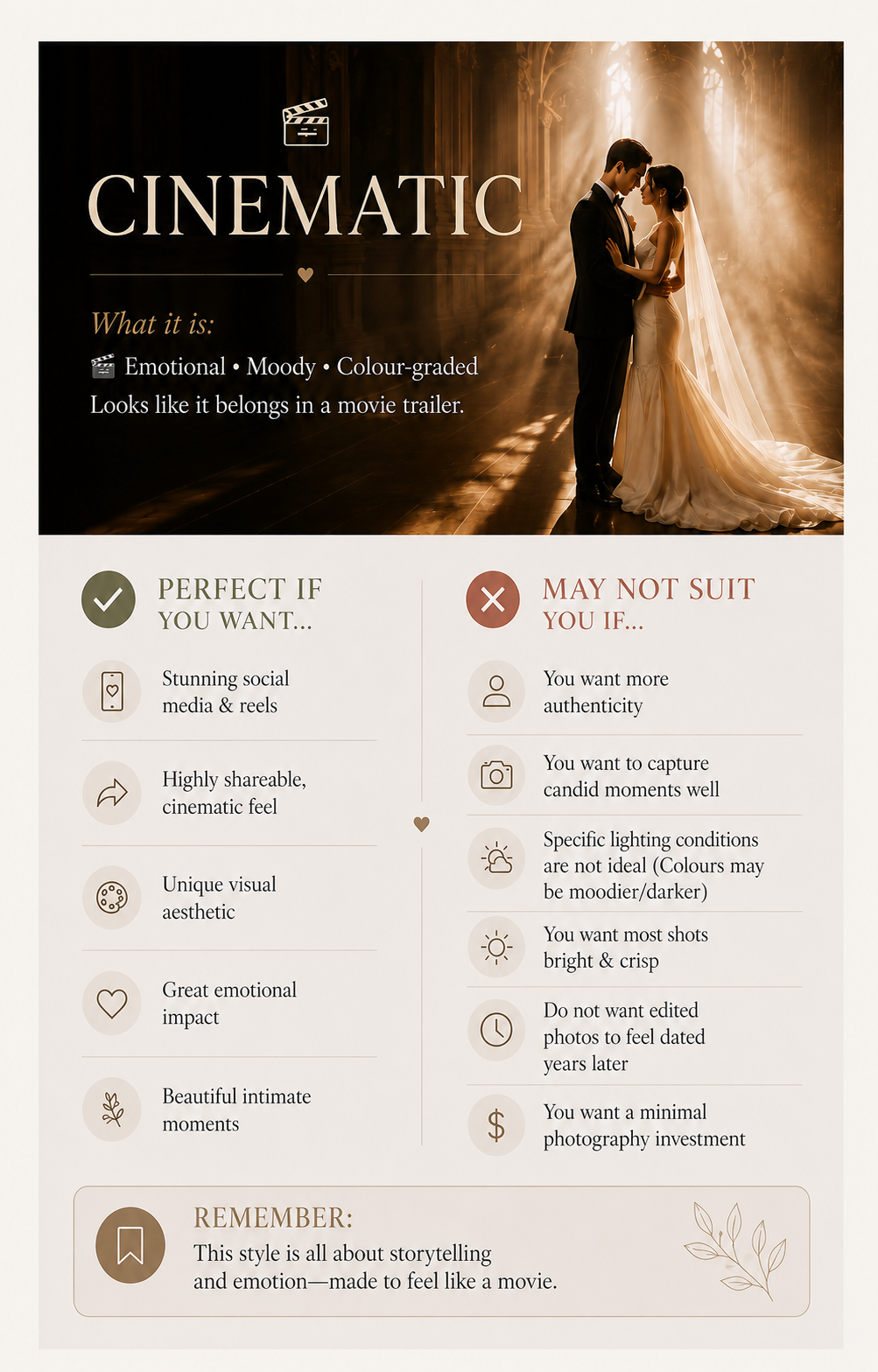
Cinematic: dramatic light and composition create atmosphere beyond a dark edit.
Cinematic wedding photography is emotional, moody, dramatic and highly atmospheric. It often looks like a still from a film. The photographer may use strong composition, directional light, deeper shadows, rich colour grading and intentional movement to create a sense of story.
Cinematic photography is not defined by dark editing alone. Composition, lighting, movement and sequencing should all contribute to the narrative; a heavy preset without those foundations is simply a dark edit.
This style works especially well for evening receptions, luxury hotel ballrooms, intimate elopements, rooftop venues, dramatic march-ins and weddings with strong lighting or decor. In Singapore, cinematic photography can be powerful for after-dark portraits, hotel corridors, city backdrops, black-tie dinners and reception entrances where lighting design becomes part of the story.
The trade-off is that cinematic editing can feel moodier or darker than some couples expect. If you want every image bright, airy and natural, a heavily cinematic approach may not suit you. Ask to see full galleries from both daytime and nighttime weddings so you can judge whether the style remains flattering across the entire day.
Timeless wedding photography style: best for elegant albums that age well
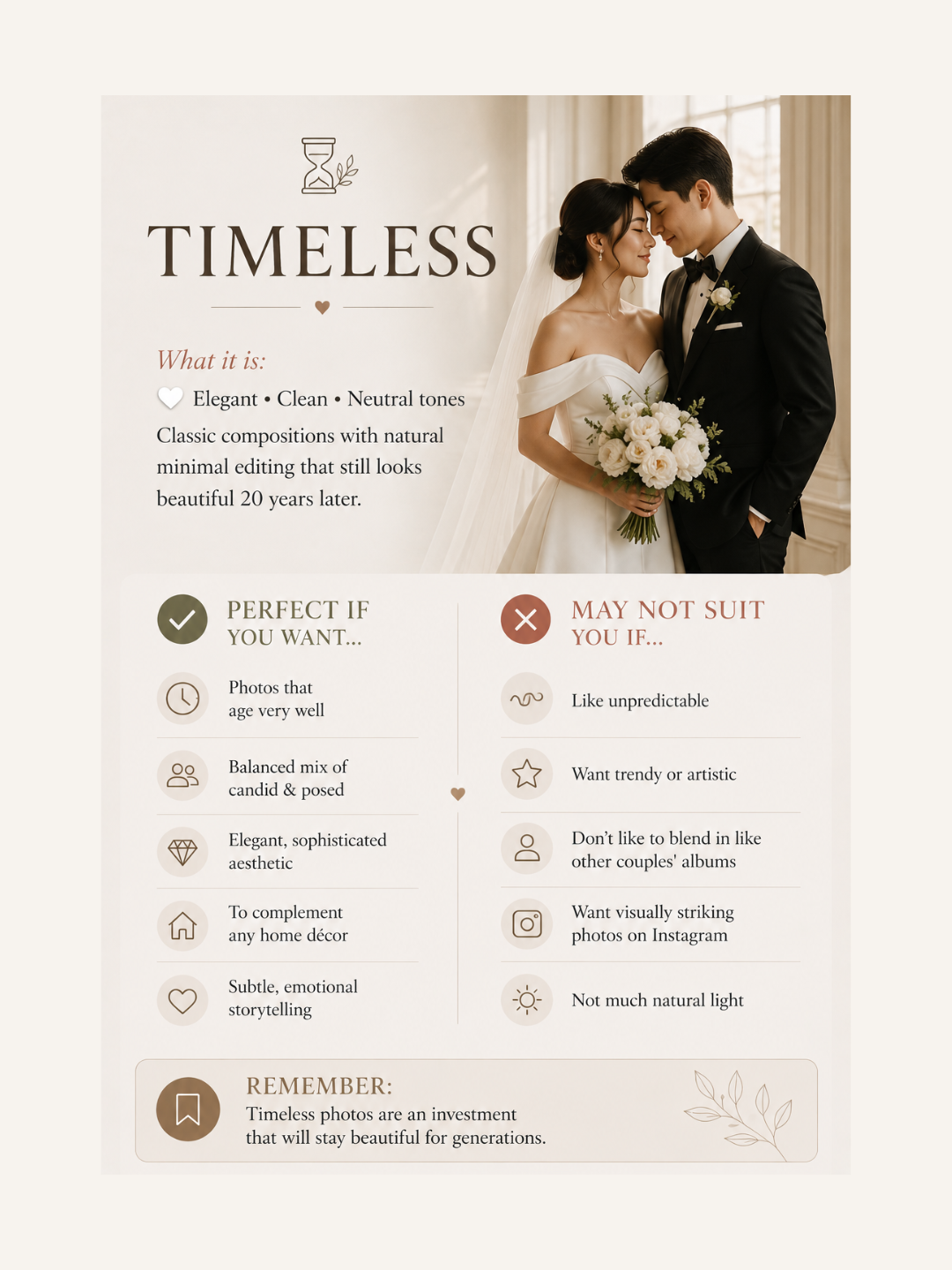
Timeless: natural colours and balanced portraits keep the album visually consistent.
Timeless wedding photography is clean, elegant, balanced and restrained. The goal is not to follow the strongest current editing trend. The goal is to create images that still feel beautiful 20 or 30 years from now. Colours are usually natural, skin tones are carefully preserved and compositions feel classic without becoming stiff.
This style suits formal weddings, garden solemnisations, hotel ballrooms, heritage venues, church ceremonies and couples who want understated sophistication. It is also strong when family expectations matter because relatives usually value clear portraits and complete coverage.
Timeless and classic are related but not identical. Timeless usually describes visual treatment and longevity, while classic photography more often describes structured coverage, formal portraiture and the reliable recording of essential moments.
The trade-off is that timeless photography may feel too quiet for couples who want viral, high-impact or fashion-led images. It is elegant rather than disruptive. If you want strong drama, experimental posing or a luxury campaign look, you may prefer editorial or cinematic photography.
Loose editorial wedding photography style: best for natural images that still look polished
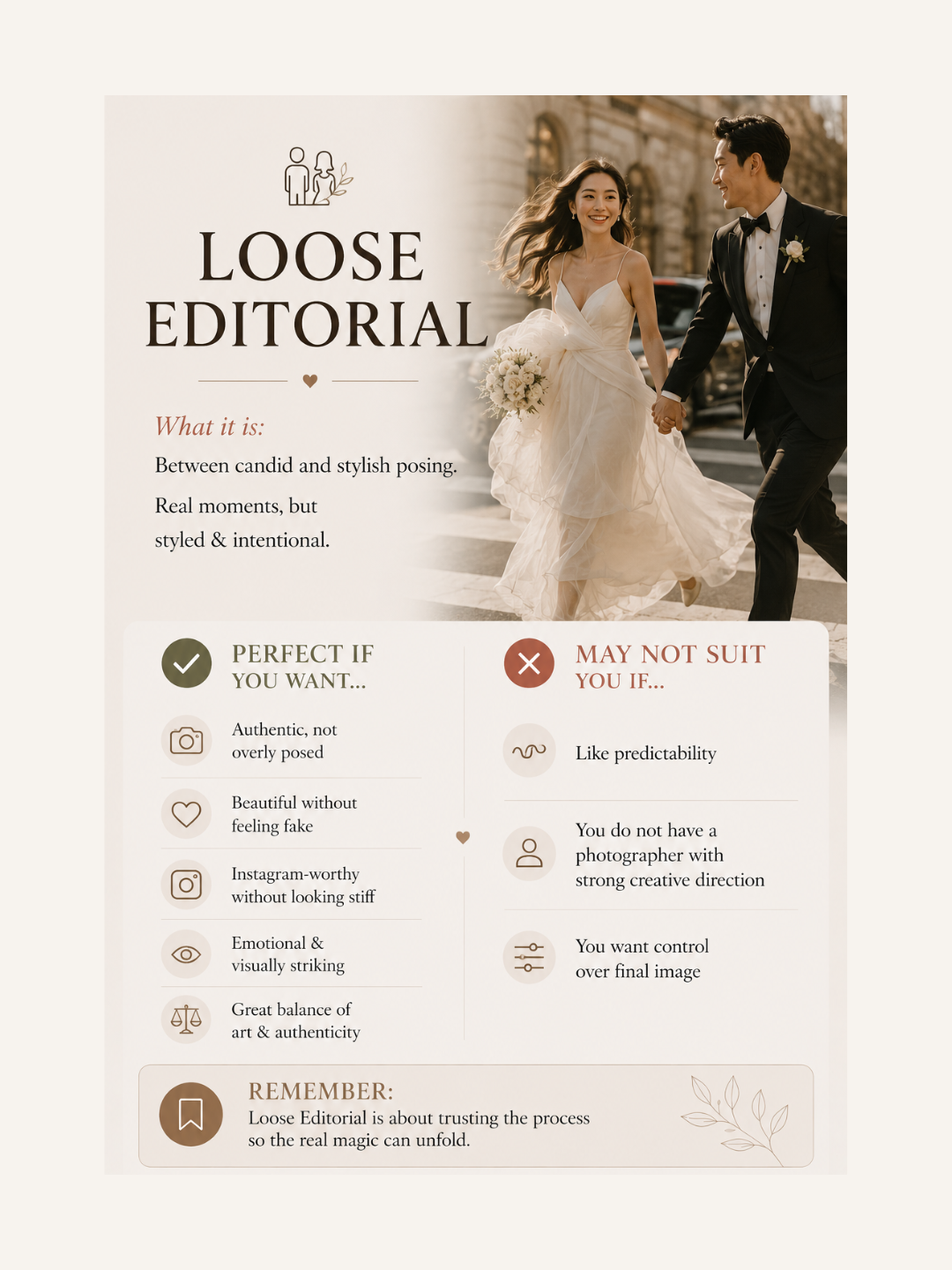
Loose editorial: gentle prompts combine natural movement with polished composition.
Loose editorial photography sits between candid and posed. It feels natural, but it is not accidental. The photographer gives light direction so your posture, movement and angles look polished while the emotion still feels believable.
This style is increasingly popular because it solves a very real problem. Many couples want stylish images, but they do not want to look overly posed. Loose editorial photography helps you look like yourself, just more composed. The photographer may ask you to walk, turn, hold hands, fix a sleeve, adjust a veil or interact naturally instead of freezing you into a formal pose.
Loose editorial is often a good fit for camera-shy couples who want more help than documentary photography provides but less posing than a fully editorial shoot requires.
The trade-off is that the style depends heavily on subtle direction. Too little guidance can look ordinary. Too much can become staged. When reviewing a portfolio, look for relaxed body language, flattering angles and emotion that still feels real.
Classic wedding photography style: best for structure, family portraits and essential coverage
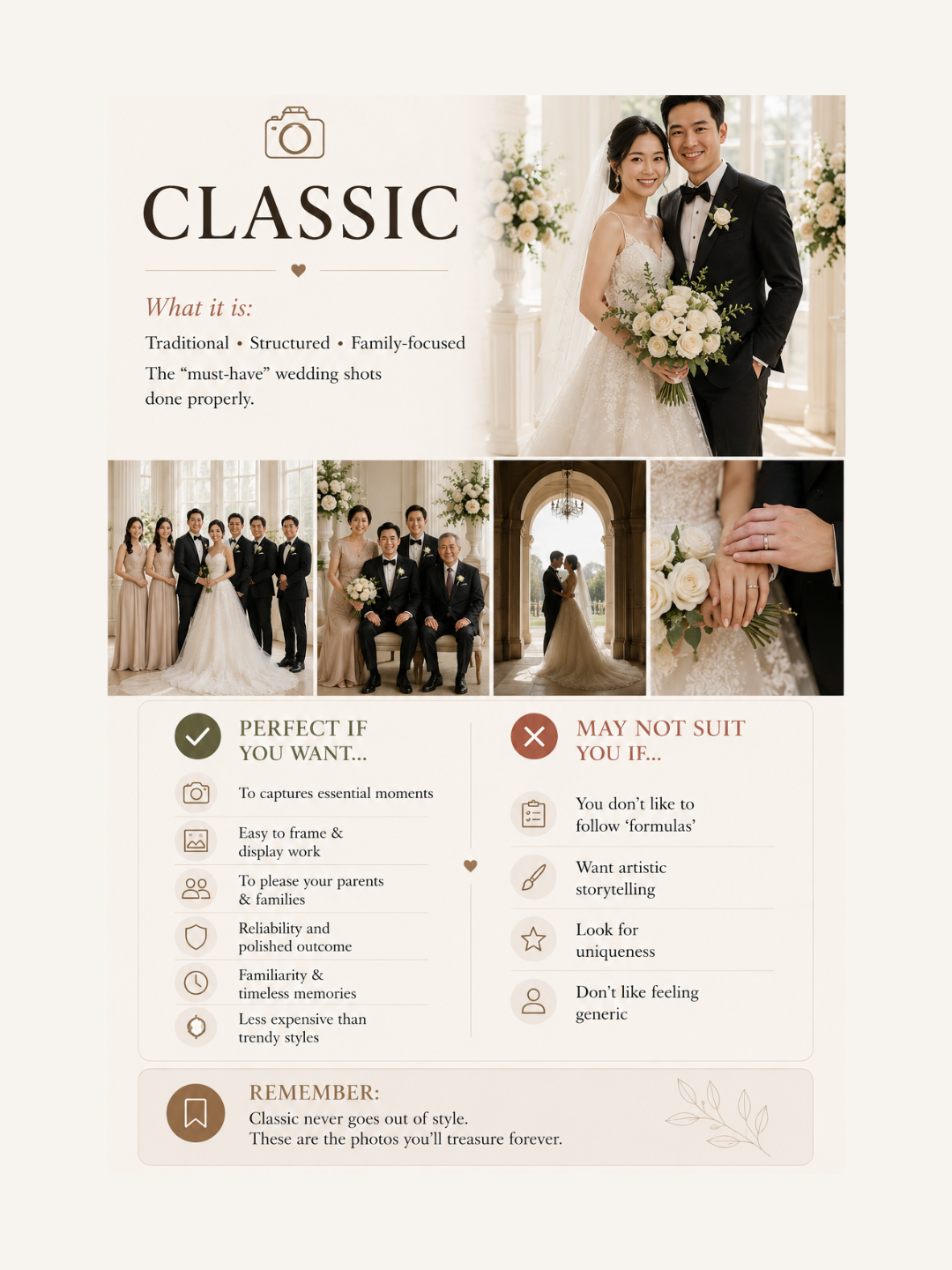
Classic: organised portraits and essential moments support complete wedding-day coverage.
Classic wedding photography is organised, traditional and complete. It prioritises the essential images: preparation, ceremony, family portraits, couple portraits, group photos, rituals, reception highlights and key emotional moments.
A strong classic photographer brings calm, speed and reliability. They know how to organise family portraits, capture important rituals, manage group shots and make sure no essential moment is missed.
Classic photography is especially relevant in Singapore weddings where the day may include home preparation, gatecrash, tea ceremony, solemnisation, lunch, banquet and reception all within a tight timeline. A photographer who can bring order to that pace can reduce stress for the couple and the family.
The trade-off is originality. Classic photography may feel predictable if you want something fashion-forward, documentary-heavy or artistically distinctive. Choose classic photography if your priority is confidence, structure and complete family-friendly coverage.
Editorial wedding photography style: best for fashion-led couples and statement styling
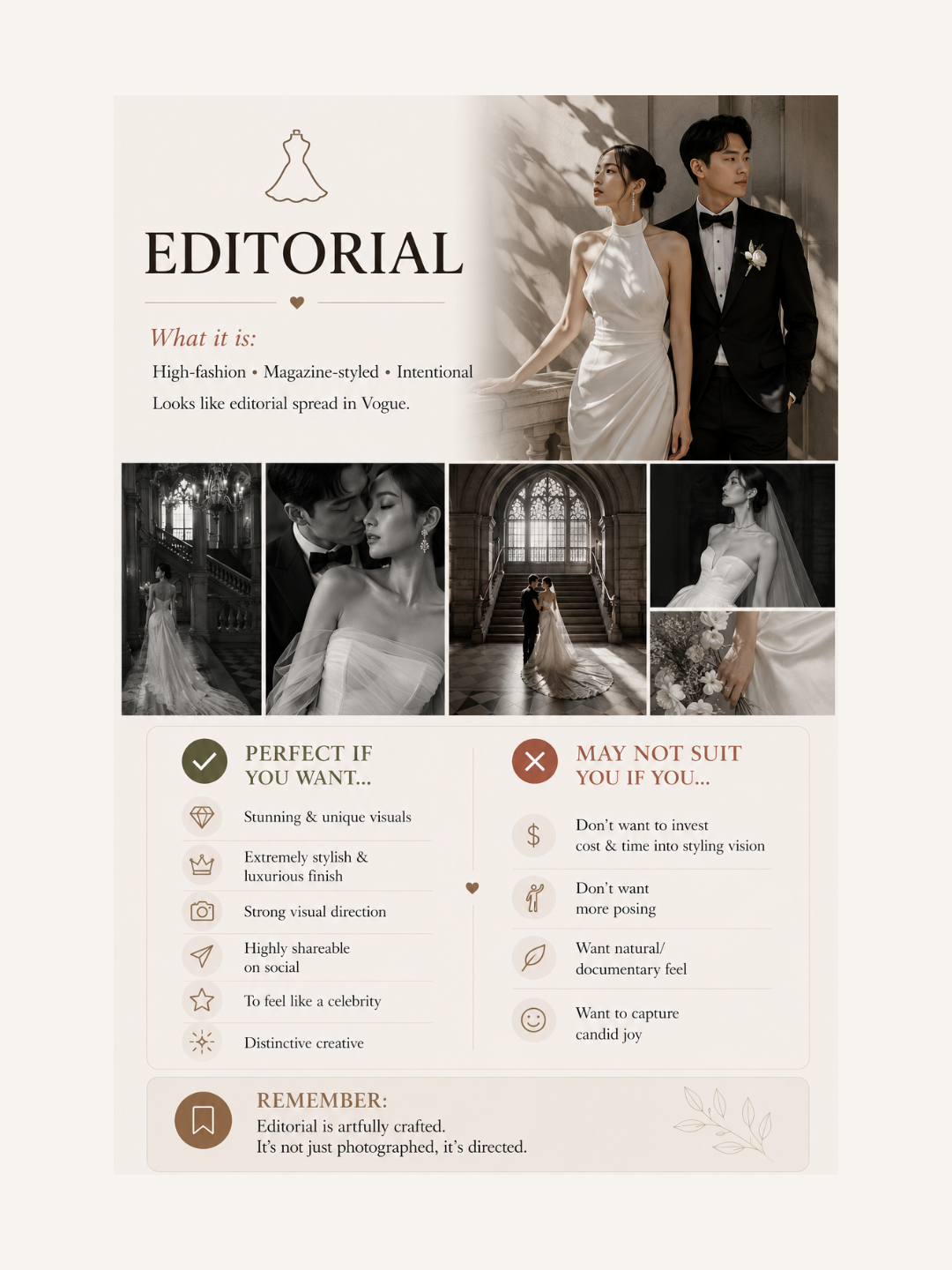
Editorial: deliberate direction gives portraits a polished, fashion-led feel.
Editorial wedding photography is polished, posed, magazine-like and highly intentional. It often feels like a luxury bridal campaign. The photographer actively directs posture, movement, expression, framing and styling so the images feel composed and elevated.
This style works beautifully with statement gowns, modern venues, statement florals, dramatic tablescapes, architectural spaces and couples who enjoy being directed.
Many photographers combine editorial posing with timeless editing. Others combine editorial direction with cinematic colour or flash-led reception imagery. Two photographers may both use the word "editorial", while one is dramatic and fashion-led and another is soft, elegant and lightly posed. Complete galleries make those differences easier to recognise before you enquire.
The trade-off is time and comfort. Editorial portraits usually need planning, enough space in the schedule and a couple who is willing to take direction. If the day is rushed or you want the photographer to disappear into the background, a strongly editorial approach may feel intrusive.
Fine art wedding photography style: best for romantic, soft and detail-rich weddings
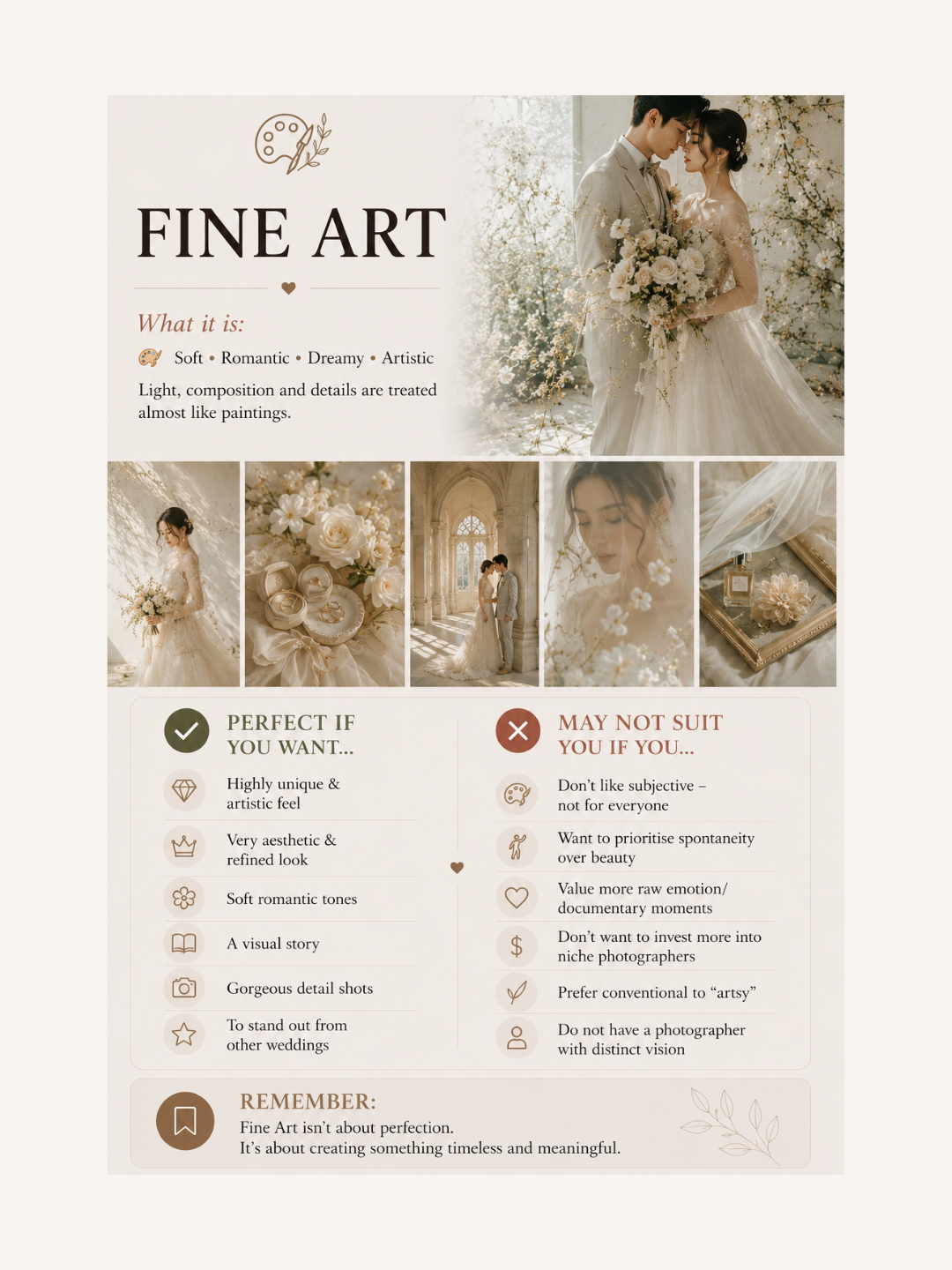
Fine art: soft light, texture and thoughtful details create a romantic visual treatment.
Fine art wedding photography is soft, romantic, dreamy and artistic. It treats light, texture, detail and emotion almost like a painting. The images may feel delicate, refined and poetic.
The term is used inconsistently: some photographers use "fine art" to describe a shooting philosophy built around composition and detail, while others use it mainly for a soft editing treatment. Ask what the label means in the photographer's own work.
This style suits garden venues, heritage buildings, romantic florals, delicate gowns, stationery details, soft colour palettes and couples who care deeply about atmosphere. It can be especially beautiful when the wedding design itself has a cohesive visual language.
The trade-off is subjectivity. Some couples may find it too soft or stylised. Fine art photography can sometimes prioritise visual beauty over raw spontaneity. That is not a flaw; it is a creative decision. The question is whether that decision matches how you want to remember the day.
Movement-led wedding photography: an emerging approach

Movement-led portraits can use walking, dancing or a gentle twirl to create energy. Photo by Alexander Mass on Unsplash.
Experiential wedding photography is an emerging, movement-led approach rather than a universally recognised standalone industry category. It is best understood as a subset or blend of cinematic and editorial photography: the photographer uses intentional prompts to create authentic-looking energy, emotion and movement. Couples may be encouraged to laugh, walk, dance, run, touch, lean, spin or interact so the image feels alive.
This style is powerful for couples who want bold emotion without a fully posed feeling. It can work beautifully during first looks, couple portraits, reception entrances, dance floors and after-party moments. It also pairs well with cinematic editing when the couple wants the images to feel immersive.
The trade-off is trust. If the photographer is not confident, the prompts can feel awkward. If the couple is uncomfortable participating, the images may look forced. Review full galleries carefully to see whether the emotional moments feel genuine or overly manufactured.
Photojournalistic and documentary wedding photography style: best for authentic storytelling
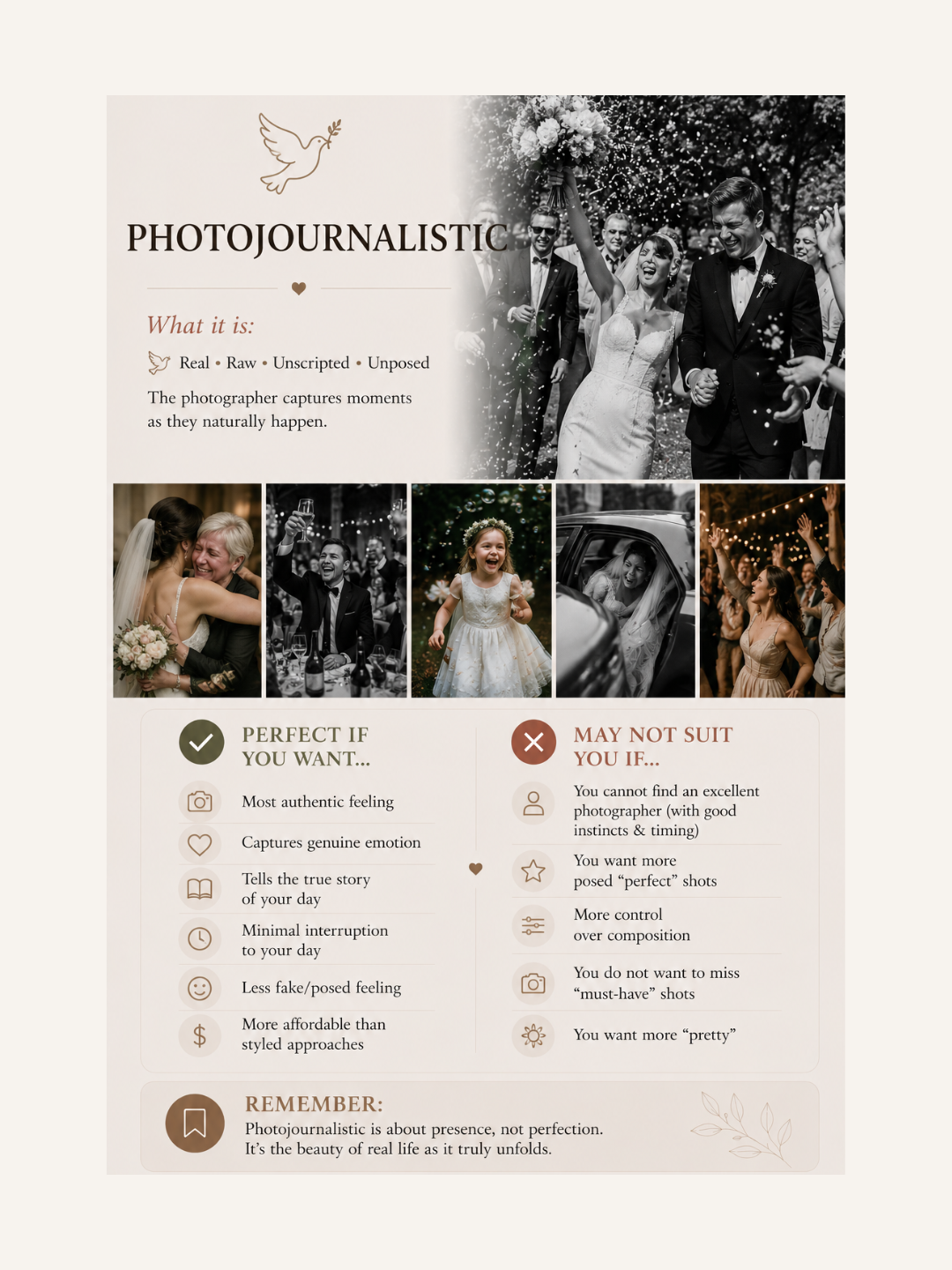
Documentary and photojournalistic: reactions and in-between moments tell the story of the day.
Photojournalistic wedding photography, often called documentary wedding photography, is real, candid, unscripted and observational. The photographer watches the day unfold and captures emotion, reactions, gestures and in-between moments without heavily interrupting the flow.
This style appeals to couples who want nervous laughter, parents' reactions, quiet hand squeezes, unexpected dance-floor moments and the details they may have missed in real time. The album feels like a record of what actually happened, not only a collection of beautiful portraits.
If authentic storytelling is important to you, ask to see complete wedding galleries rather than Instagram highlights. A complete gallery helps you evaluate consistency across preparation, ceremony, family portraits, dinner, speeches and reception moments.
The trade-off is control. You may not get as many posed-perfect images. Composition depends on what happens naturally. If you have a long must-have shot list, pure documentary photography may not satisfy you. The photographer also needs excellent instincts because missed moments cannot be recreated.
How to choose a wedding photography style for your venue type in Singapore
Singapore weddings often move through several lighting environments in one day. Morning preparation may happen at home with mixed window light and ceiling light. Solemnisation may be in a glasshouse, restaurant, church, hotel, garden or beach club. Dinner may shift into a ballroom with changing artificial light. Outdoor portraits may need to work around heat, humidity and sudden rain.
The Meteorological Service Singapore records plentiful rainfall across the year, with an average of 171 rain days and long-term mean annual rainfall of 2,113.3mm. For wedding photography, this means outdoor plans should always include a wet-weather option, covered portrait areas and a photographer who can adapt quickly when light changes.
Venue or setting | Styles that often work well | What to ask the photographer |
|---|---|---|
Hotel ballroom | Timeless, classic, cinematic, editorial | Can you show low-light reception galleries with flash and ambient light? |
Garden solemnisation | Fine art, timeless, loose editorial, documentary | How do you handle harsh midday sun, humidity and sudden rain? |
Heritage venue | Timeless, fine art, editorial, classic | Can you use architecture without making portraits feel stiff? |
Restaurant wedding | Documentary, classic, loose editorial | How do you work in tight spaces and mixed lighting? |
Rooftop or city view | Cinematic, editorial, experiential | Can you shoot after sunset without making skin tones look unnatural? |
Home tea ceremony | Classic, documentary, timeless | How do you capture family rituals respectfully in crowded rooms? |
Venue fit is one of the fastest ways to refine your shortlist. A photographer whose portfolio is full of bright outdoor portraits may still be excellent, but if your wedding is mostly indoors, you need proof that they can handle ballroom lighting, flash, skin tones and fast-moving moments.
Lighting, architecture and decor also influence how a photography style translates on camera. The companion Wedding Venue Decor Guide explains how the room itself shapes the final visual result.
The Weddingserv STYLE Framework for Choosing a Wedding Photography Style
Use the STYLE framework to turn visual inspiration into a shortlist. It keeps the decision anchored to how you want the wedding to feel, not only to isolated images you have saved.
Letter | Decision question | What it reveals |
|---|---|---|
S - Shooting approach | Do you want posed, prompted or observational coverage? | The amount of direction you will receive. |
T - Tone and editing | Do you prefer natural, airy, cinematic or dramatic treatment? | How colour, contrast and skin tones will look. |
Y - Your personality | Are you camera-confident, camera-shy or happiest when ignored? | Whether active posing or quieter coverage will feel comfortable. |
L - Location and lighting | Is the wedding mainly in a ballroom, outdoors, at home or in a glasshouse? | Whether the photographer has relevant lighting experience. |
E - Essential moments | Do family portraits, emotion, fashion or atmosphere matter most? | Which portfolio strengths deserve the greatest weight. |
Apply the framework in order. First choose the shooting experience you can enjoy, then the visual treatment you want, and finally test both against your venue and essential moments. A style that looks beautiful but makes you uncomfortable on the day is not the right fit.
Which Wedding Photography Style Suits You? A Guide for Camera-Shy, Introverted and Fashion-Loving Couples
The right style is not only about the venue. It is also about how you want to feel on the day.
If you... | You may prefer... | Why it works |
|---|---|---|
Hate posing and want to feel unobserved | Photojournalistic or documentary | The photographer focuses on real moments with minimal interruption. |
Want guidance but still want natural emotion | Loose editorial | You get flattering direction without stiff posing. |
Want your album to age beautifully | Timeless | Natural colours and classic compositions stay elegant for longer. |
Love fashion, gowns and statement details | Editorial | The photographer builds strong, polished hero images. |
Want drama and emotional intensity | Cinematic or experiential | Light, movement and atmosphere make the gallery feel immersive. |
Need family expectations handled calmly | Classic | The photographer prioritises complete coverage and organised portraits. |
Care deeply about romance and visual softness | Fine art | Light, texture and detail become part of the emotional language. |
It is useful to identify your preferred photography style before comparing prices because editing style cannot be completely changed after the wedding. Small adjustments are possible, but a photographer's signature approach is usually built into how they shoot, direct, light and edit.
Wedding Photography Style Blends: What Singapore Couples Actually Choose
In real weddings, most couples do not choose one pure style. They choose a blend. This is one of the most important insights for couples because portfolio labels can be misleading.
A common Singapore wedding blend is classic coverage for the family rituals, documentary coverage during the ceremony, timeless editing across the full gallery and cinematic portraits after sunset. Another couple may want editorial images during preparation because they invested heavily in the gown, loose editorial couple portraits before dinner and candid storytelling during speeches. A third couple may want fine art details, classic family formals and photojournalistic reception coverage.
Current Weddingserv listings illustrate why labels should be treated as starting points. Coexist Visuals describes a cinematic editorial approach; Le Palolem lists loose editorial packages; Happy Eyes Photography combines classic, photojournalistic and timeless treatment; and Pengyu Official lists classic and editorial packages while describing emotional and cinematic influences.
Look beyond the label and ask, "Which parts of the day does this photographer naturally do best?" One photographer may excel at editorial portraits but be less distinctive during candid reception moments. Another may be a strong documentary storyteller but less confident with polished fashion-led direction.
The strongest shortlist usually includes photographers whose natural strengths match your most important moments.
How to Research Wedding Photographers in Singapore Without Wasting Time
Researching wedding photographers can become messy quickly. Couples browse Instagram, save hundreds of screenshots, forget who photographed what, enquire with ten photographers, wait for replies, receive different quotation formats and struggle to compare hours, deliverables, editing style, second shooters, albums and add-ons.
By the time they are ready to decide, they may have a camera roll full of inspiration but no clear shortlist.
Weddingserv cuts through the noise by bringing photographer profiles and current package listings into one place. Couples can compare real portfolio directions and package language before opening several separate enquiry conversations.
Not sure which photographer fits your style? Book a complimentary 1:1 Wedding Photographer Comparison session. Tell us your preferred photography style, venue and budget, and we will help you compare suitable Weddingserv photographers.
That does not replace personal judgement. Couples should still review portfolios, ask for full galleries, speak with photographers and check chemistry before booking. But it removes a major layer of friction: the scattered research stage where couples lose track of who offers what.
How to Compare Wedding Photographers in Singapore After Choosing Your Style
Once you know the style you want, compare photographers using the same criteria.
Full-gallery consistency: Does one full wedding look strong from preparation to reception, or only in highlights?
Venue relevance: Has the photographer handled a wedding similar to your venue, lighting and schedule?
Direction style: Do they pose actively, guide lightly or observe quietly?
Editing consistency: Are skin tones, colour and exposure stable across different lighting?
Package inclusions: Are coverage hours, edited images, second shooters, albums and turnaround clear?
Personality fit: Would you feel comfortable with this person during emotional, intimate and busy moments?
Backup process: Do they have backup equipment and file storage safeguards?
While Instagram is useful for inspiration, complete galleries reveal far more about consistency. Review vendor profiles and package information only after you have established which visual approach matters most.
For the deeper checklist covering packages, consultations, contracts, backup systems and venue fit, continue with How to Choose the Right Wedding Photographer in Singapore. That companion guide keeps this article focused on style while helping you turn visual preferences into a practical booking decision.
Wedding photography styles FAQ
What is the difference between documentary and photojournalistic wedding photography?
They are often used interchangeably. Both describe a candid, story-led approach where the photographer observes real moments instead of heavily directing them. "Documentary" often suggests full-day storytelling, while "photojournalistic" can imply a sharper instinct for moments, reactions and timing.
Can a photographer shoot more than one wedding photography style?
Yes. A photographer may shoot documentary coverage during the ceremony, classic family portraits after solemnisation and loose editorial couple portraits before dinner. The key is whether their portfolio shows consistent strength in the blend you want.
Which wedding photography style is the most timeless?
Timeless and classic photography usually age best because they rely on natural colour, clean composition and balanced editing rather than heavy trends. Loose editorial can also age well when the editing is restrained.
Which wedding photography style requires the most posing?
Editorial photography usually requires the most posing. Cinematic and movement-led experiential approaches can also involve active prompting. Documentary photography requires the least posing, while loose editorial sits in the middle.
Which wedding photography style is best for hotel weddings?
Timeless, classic, editorial and cinematic styles often work well for Singapore hotel weddings because they suit ballrooms, formal portraits, luxury styling and evening receptions. Review low-light galleries before booking.
Which wedding photography style suits outdoor weddings in Singapore?
Fine art, timeless, loose editorial and documentary styles often suit outdoor solemnisations and garden venues. Ask how the photographer handles wet-weather backup plans and harsh midday sun.
Can editing style be changed after the wedding?
Only to a limited extent. Minor adjustments may be possible, but a photographer's signature look is shaped by how they shoot, light and edit from the beginning. Choose a portfolio that already looks close to what you want.
Which wedding photography style is trending in Singapore?
There is no authoritative public Singapore-wide ranking of wedding photography styles. Couples frequently encounter loose editorial, timeless and photojournalistic blends because they balance polished portraits with natural coverage.
Treat trends as inspiration rather than a rule: the stronger choice is the style that suits your venue, personalities and preferred level of direction.
Is cinematic wedding photography timeless?
Cinematic photography can age well when colour grading is restrained, skin tones remain natural and the dramatic lighting supports the story. Heavy filters or effects tied closely to a short-lived trend may date faster. Review complete daytime and evening galleries to decide whether the photographer's cinematic treatment still feels balanced across the full wedding.
Which wedding photography style is best for introverts?
Photojournalistic or documentary photography often suits introverts because the photographer observes rather than directing every moment. Loose editorial can also work well when the couple wants gentle guidance without prolonged posing. Ask how the photographer gives prompts, manages quiet moments and keeps portrait sessions from feeling performative.
Which wedding photography style is easiest for camera-shy couples?
Loose editorial is often the easiest starting point for camera-shy couples. Instead of asking for a fixed pose, the photographer may prompt walking, talking, holding hands or adjusting a veil so attention shifts away from the camera. A documentary-led approach may feel even more natural during the ceremony and reception.
How to Choose Your Wedding Photography Style With Confidence
There is no single best wedding photography style. There is only the style that feels most like you.
Some couples will choose cinematic drama. Some will choose timeless elegance. Some will choose editorial polish. Others will choose documentary honesty. Many will choose a blend, using different styles for different parts of the day. What matters is that the photographer understands your priorities and can deliver that approach consistently across the entire wedding.
Once you have identified the photography style that best reflects your personalities, compare curated photographer profiles and current photography packages using the same criteria. The goal is not to find the most impressive isolated image. It is to find a photographer whose complete work consistently reflects the way you want to remember your wedding.
The right photographer will not just make your wedding look beautiful. They will help you remember it honestly, elegantly and in a way that still feels like you years later.
Source Notes
Singapore rainfall figures are from the Meteorological Service Singapore climate overview, using the 1991-2020 reference period.
Photography package observations were checked against the linked Weddingserv listings on 24 July 2026. Prices, inclusions and availability can change; couples should verify the current listing and written quotation before booking.